Federal Funding, Hidden Exposure: How CHIPS Act Recipients Are Quietly Building IP Vulnerabilities Into Their Growth Plans
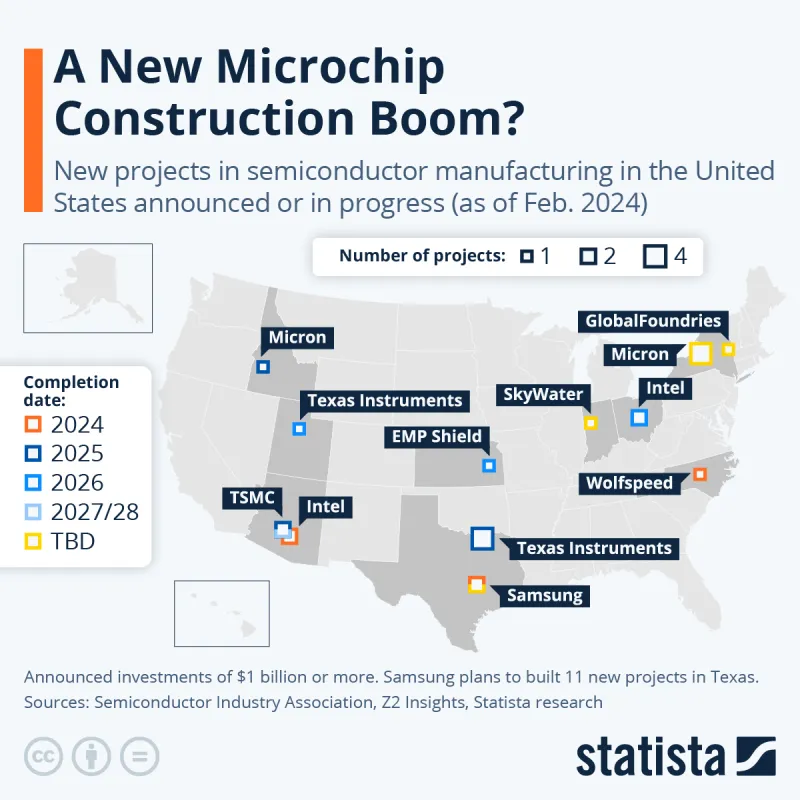
Photo: semiconductor manufacturing facility federal funding US technology, via cdn.statcdn.com
The Funding Surge Nobody Is Fully Prepared For
The CHIPS and Science Act represents one of the most substantial federal investments in domestic manufacturing in a generation. For mid-market companies in the semiconductor, advanced electronics, and precision manufacturing sectors, the opportunity is real — and so is the urgency. Grant applications are moving quickly, joint ventures are forming at pace, and supply chain realignment is accelerating across the country.
What is not moving at the same pace is intellectual property strategy.
As companies scramble to position themselves for federal funding and capitalize on nearshoring momentum, their IP infrastructure is quietly falling behind. Patent portfolios are being stretched to cover new manufacturing processes they were never designed to protect. Technology transfer agreements are being signed without adequate scrutiny of ownership provisions. Foreign subsidiary structures that made sense under a globalized supply chain model are now creating unexpected compliance friction under federal grant conditions.
The result is a class of companies that are financially better positioned than they have been in years, yet more legally exposed than their leadership teams realize.
What CHIPS Act Compliance Actually Requires From IP Holders
Most mid-market executives understand, at a general level, that CHIPS Act funding comes with strings attached. Restrictions on expanding manufacturing in certain foreign countries — most notably China — are widely discussed. What receives far less attention are the IP-specific obligations that accompany federal awards.
Grant recipients are subject to government license provisions under the Bayh-Dole Act framework when federal funding touches research and development activity. This means the federal government retains certain rights to inventions developed with federal support — a fact that can materially affect how a company licenses, assigns, or monetizes its technology portfolio downstream. Companies that fail to disclose covered inventions or that transfer IP without proper government authorization may face grant termination, repayment demands, or debarment from future federal programs.
Additionally, technology transfer agreements executed as part of joint manufacturing ventures must be carefully reviewed for provisions that could conflict with CHIPS Act guardrails. A licensing arrangement that permitted broad technology sharing with an overseas partner may now put a company in technical violation of its grant conditions — even if that agreement predates the federal award.
Joint Ventures: Where IP Ownership Gets Complicated Fast
The push toward domestic semiconductor and electronics manufacturing has triggered a wave of joint ventures between US companies, between US and allied-nation partners, and between private manufacturers and research institutions. Each of these structures introduces IP ownership complexity that, if left unaddressed, can become a serious liability.
In a joint development agreement, questions of inventorship, ownership, and licensing rights must be resolved explicitly and in advance. Too often, mid-market companies enter these arrangements with boilerplate agreements that were drafted for a different commercial context. When a novel manufacturing process emerges from the collaboration, the question of who owns it — and who can license it to third parties — may not have a clear answer.
For companies receiving federal manufacturing grants, this ambiguity is particularly dangerous. If a jointly developed invention is subject to a government license by virtue of federal funding, and the joint venture agreement does not address that contingency, both parties may find themselves constrained in ways they did not anticipate when the deal was signed.
Engaging qualified IP counsel before a joint venture agreement is executed — not after the collaboration has begun producing results — is not a luxury in this environment. It is a basic risk management requirement.
Patent Portfolio Gaps That Federal Funding Tends to Expose
Many mid-market manufacturers built their patent portfolios around their existing production processes and product lines. As CHIPS Act incentives prompt companies to expand into new manufacturing capabilities, those portfolios frequently do not extend to the new territory.
This creates two distinct problems. First, a company investing in new domestic manufacturing capacity may be doing so using processes that are already patented by a competitor — and without the freedom-to-operate analysis needed to confirm that it can proceed without infringing. Second, the innovations that emerge from the expansion may be left unprotected simply because the company has not established a systematic process for identifying and filing on new patentable subject matter.
Both problems are solvable, but neither is solved automatically by the act of receiving federal funding. A structured patent portfolio audit — one that maps existing IP assets against the company's new manufacturing scope and identifies gaps requiring either new filings or licensing arrangements — is an essential precursor to full-scale production expansion.
Foreign Subsidiary Structures Under Renewed Scrutiny
For companies that built their supply chains around global manufacturing networks, the CHIPS Act introduces a new layer of structural complexity. Federal grant conditions impose meaningful restrictions on recipients' ability to expand semiconductor manufacturing capacity in countries of concern. But many mid-market companies have existing subsidiary structures, equity stakes, or technology licensing arrangements in those jurisdictions that were established long before the current policy environment took shape.
These legacy structures require careful review. A foreign subsidiary that receives technology transfers from a US parent — even for manufacturing purposes unrelated to semiconductors — may create compliance exposure if the parent is a CHIPS Act grant recipient and the transfer implicates covered technology. The analysis is fact-specific, but the consequences of getting it wrong are significant enough to warrant a proactive legal review rather than a reactive one.
Companies should work with counsel experienced in both federal grant compliance and international IP licensing to map their existing foreign arrangements against current regulatory requirements before the next funding tranche is awarded.
The Window for Proactive Action Is Narrowing
Federal manufacturing funding is not unlimited, and the competitive pressure to secure grants and establish joint ventures is only intensifying. Companies that take the time now to conduct thorough IP audits, restructure problematic technology transfer agreements, and align their patent portfolios with their expanded manufacturing ambitions will be meaningfully better positioned — both to protect their federal incentives and to capture the commercial value their investments are designed to generate.
Companies that defer this work until after a grant is awarded, a joint venture is operating, or a compliance question is raised by a federal agency will face a far more constrained set of options.
The CHIPS Act represents a genuine opportunity to rebuild American manufacturing competitiveness. Realizing that opportunity fully requires treating intellectual property strategy not as an afterthought to operational expansion, but as a foundational element of the growth plan itself. The companies that understand this distinction will be the ones that emerge from this investment cycle with both their federal funding intact and their IP position strengthened.
For mid-market manufacturers navigating this landscape, the time to act is before the next milestone — not after it.